Shanghai Weekly Bulletin is an information service presented by the Foreign Affairs Office of Shanghai Municipal People’s Government in collaboration with Wolters Kluwer to foreign-funded enterprises, foreign-related institutions as well as people from overseas living in Shanghai. Covering major national and Shanghai foreign-related news, event information, policy Q&A and interpretations in the past week, it keeps you up-to-date with the latest foreign-related policies and developments in Shanghai.
If you have any comments or suggestions for Shanghai Weekly Bulletin, please feel free to send an email to [email protected]. Thank you!
1
Laws and Regulations
【National】
Revised Regulations for the Implementation of the Audit Law of the People’s Republic of China Released
Implementing Rules for the Regulations on Integrated Circuit Layout-Design Protection Released
People’s Bank of China Adjusts and Refines Monetary Policy Tools
Eight Authorities Jointly Issue Guidelines on Financial Support for Service Sector Expansion and Upgrading
CNIPA Seeks Public Comments on Draft Guidelines for Trademark Examination and Adjudication
【Shanghai】
Shanghai Issues Provisions on Promoting and Regulating Commercial Mediation
Shanghai Financial Court Issues Guidelines on Judicial Review of Securities and Futures Arbitration
2
Q&A
An official from the Ministry of Culture and Tourism outlined the new initiatives and highlights of the 25th China Shanghai International Arts Festival in developing platforms for international cooperation and deepening cultural exchanges and mutual learning between China and other countries.
3
Expert Perspective
Tiered Adjudication and Matters Left Open by the Rules in AI Disputes: An Interpretation of and Practical Outlook on the Opinions of the Supreme People’s Court on Lawfully Adjudicating Cases Involving AI-Related Disputes (Part IV)
4
One Week in Shanghai
【Latest News】
Shanghai Holds 38th IBLAC Meeting
Shanghai Promotional Film Released for 9th CIIE
Shanghai’s National Day Holiday Spending Reaches RMB 76.24 Billion
Shanghai Records 20.21 Million Tourist Visits During National Day Holiday
Luojing Container Terminal’s Phase I Renovation Opens to Expand Shanghai’s Container Capacity
Greenland Bund Global Customization Center Opens with First-Store Launches and Brand Debuts
Pudong Welcomes “1+3” Technical Bodies of International Standardization Organizations
SHFE Opens Eight Additional Products to QFIs to Achieve Near-Full Access
【Corporate Activities】
Austria’s UBIQUE Establishes Presence in Minhang with Plan for Group’s Second-Largest R&D Center
EVAPCO’s Phase IV Plant Begins Operations
【Competition Events】
2026 Buick LPGA Shanghai Set to Tee Off
【Culture & Arts】
25th China Shanghai International Arts Festival to Run from October 17 to November 15
West Bund Theatre Unveils 2026/27 “Human 2 Human” New Year Season
Laws and Regulations
National
1.Revised Regulations for the Implementation of the Audit Law of the People’s Republic of China Released
[Keywords: Audit law]
The Regulations for the Implementation of the Audit Law of the People’s Republic of China were recently revised and released. The revision introduces a system for recording and reporting improper inquiries into or interference in audit matters to ensure that audit work remains free from interference. It also specifies more detailed requirements for audited entities and relevant authorities to assist audit institutions in their work. The document will take effect on December 1, 2026.
2.Implementing Rules for the Regulations on Integrated Circuit Layout-Design Protection Released
[Keywords: Integrated circuits, Layout-designs]
The China National Intellectual Property Administration (CNIPA) recently released the revised Rules for Implementing the Regulations on the Protection of Layout-Designs of Integrated Circuits. The main revisions cover three areas: optimizing registration applications and related procedures and standardizing administrative processes and formalities; improving the re-examination and revocation systems to enhance the quality and efficiency of registration and rights confirmation; and strengthening the protection of exclusive rights to layout-designs and promoting their use. The document will come into force on October 30, 2026.
Source: CNIPA
https://www.cnipa.gov.cn/art/2026/9/30/art_74_208390.html
3.People’s Bank of China Adjusts and Refines Monetary Policy Tools
[Keywords: Monetary policy tools]
Building on the effective implementation of existing policies, the People’s Bank of China (PBC) recently decided to further adjust and refine several monetary policy tools. The adjustments aim to create monetary and financial conditions conducive to steady economic growth, high-quality development, and stable financial market operations, promote innovation-driven, high-quality economic development, and support a strong start to the 15th Five-Year Plan period.
4.Eight Authorities Jointly Issue Guidelines on Financial Support for Service Sector Expansion and Upgrading
[Keywords: Finance, Service sector]
The People’s Bank of China (PBC), together with seven other authorities, recently issued the Guiding Opinions on Financial Support for Expanding the Capacity and Enhancing the Quality of the Service Sector. The document emphasizes building a multi-tiered institutional framework for financial services and increasing financial support for producer services to help strengthen capabilities in sci-tech services, modern logistics, business services, and other sectors.
5.CNIPA Seeks Public Comments on Draft Guidelines for Trademark Examination and Adjudication
[Keywords: Trademark examination]
The CNIPA recently invited public comments on the Guidelines for Trademark Examination and Adjudication (Draft for Public Comments). The document provides more detailed provisions in nine areas, including the formal and substantive examination of motion trademark applications, the examination and adjudication of signs prohibited from use as trademarks, and the non-functionality examination of color-combination and sound trademarks. The deadline for submitting comments is November 12, 2026.
Shanghai
1.Shanghai Issues Provisions on Promoting and Regulating Commercial Mediation
[Keywords: Commercial mediation]
The General Office of the Shanghai Municipal People’s Government recently issued the Several Provisions of Shanghai Municipality on Promoting and Regulating the Development of Commercial Mediation. The document further improves the regulatory framework for the commercial mediation sector in various aspects, including clarifying the division of responsibilities, specifying establishment and market access criteria, and promoting the internationalization of commercial mediation. The document took effect on October 1, 2026, and will remain valid until September 30, 2031.
Source: Shanghai Municipal People’s Government
2.Shanghai Financial Court Issues Guidelines on Judicial Review of Securities and Futures Arbitration
[Keywords: Securities and futures, Judicial review of arbitration]
The Shanghai Financial Court recently issued the Guidelines on Judicial Review of Securities and Futures Arbitration. The document applies to cases involving judicial review of securities and futures arbitration handled by the Shanghai Financial Court, primarily covering contractual disputes involving securities, futures, and derivatives, as well as civil claims for damages arising from securities misrepresentation, market manipulation, insider trading, and similar conduct.
Q&A
An official from the Ministry of Culture and Tourism answered questions from the media at a press conference on the 25th China Shanghai International Arts Festival (CSIAF) hosted by the Information Office of the Shanghai Municipal People’s Government.
Q
As an internationally influential cultural brand and an important cultural showcase, what new initiatives and highlights does this year’s festival offer in building platforms for international cooperation and deepening cultural exchanges and mutual learning between China and other countries?
A
The CSIAF is a major international arts festival in China and an important platform for cultural exchanges between China and other countries. This year’s festival focuses on bringing together international performing arts resources, pooling industry expertise, and building a global cooperation network. Nearly 20,000 artists, institutional representatives, and industry experts from more than 80 countries and regions will participate, engaging in exchanges and cooperation through performing arts showcases, industry dialogues, project negotiations, and other activities during the festival.
In terms of bringing together international performing arts resources, the International Performing Arts Fair of CSIAF is expected to welcome more than 2,000 Chinese and international guests from over 50 countries and regions. This year, it will introduce a new format combining streamlined exhibition arrangements with targeted business meetings. Plans include 30 video presentations and 18 live presentations, doubling the total number of projects compared with previous editions. The fair will introduce outstanding Chinese and international productions to buyers worldwide, including Daphnis and Chloé from the Southbank Centre in London, UK, and Gravitational Ties from the Shanghai Acrobatic Troupe. It will also collaborate with the Hong Kong Performing Arts Expo to share guest networks and coordinate itineraries, and hold dedicated seminars to mark the China-Brazil Year of Culture.
In terms of bringing together industry expertise, the International Dialogues section of CSIAF will invite leaders of renowned cultural institutions from China and abroad to discuss the industry’s development prospects under the theme “Arts Without Borders, Civilizations in Symbiosis”. The program will also feature eight specialized dialogues on topics including youth empowerment and the global stage, and co-creating cultural and tourism destinations. The festival’s opening day will coincide with the official opening of the Shanghai Grand Opera House. An inaugural summit dialogue will be held under the theme “United in Opera: Singing for All, Resonating with the World”. Leaders of renowned Chinese and international opera houses, including the Vienna State Opera, the UK’s Royal Ballet and Opera, and China’s National Centre for the Performing Arts, will be invited to explore topics such as integrating the arts into urban life and bringing Chinese opera to the world stage.
In terms of building a global cooperation network, the Network of Silk Road Arts Festivals, jointly initiated by CSIAF, has continued to grow and now has more than 200 member institutions. During this year’s festival, more than 40 member institutions, including Romania’s Sibiu International Theatre Festival and Türkiye’s Istanbul Foundation for Culture and Arts, will participate in exchanges, with preliminary agreements expected on more than 10 cooperation projects. With support from the Belt and Road Special Project under the Rising Artists’ Works (R.A.W.!) program, outstanding productions from Brazil, Chile, Russia, and other countries will be staged in China. This year, the festival is also helping bring 25 Chinese productions to international festival stages. Preparations for all aspects of this year’s festival are moving forward.
Expert Perspective
Tiered Adjudication and Matters Left Open by the Rules in AI Disputes: An Interpretation of and Practical Outlook on the Opinions of the Supreme People’s Court on Lawfully Adjudicating Cases Involving AI-Related Disputes (Part IV)
By Fu Gang [Dacheng Law Offices (Shanghai)]
[Continued from the Previous Issue]
[Article Overview]
This section examines the Opinions of the Supreme People’s Court on Lawfully Adjudicating Cases Involving AI-Related Disputes, explaining the notice-and-action rules for infringements of personality rights and interests by generative AI, as well as liability determination in scenarios involving product defects, consumer transactions, and autonomous driving. The article notes that upon receiving a valid notice, service providers must promptly take necessary measures, such as ceasing the generation of infringing content. However, receipt of notice is not the sole trigger for all forms of liability. When personality rights and interests face irreparable harm, injunctions may be sought in accordance with the law. For AI products embodied in tangible goods, algorithm-based differential treatment in transactions, celebrity impersonation in live-stream sales, and driving accidents, liability should be assessed under the applicable legal rules, with obligations to provide data helping establish the facts. A reasonable balance should be maintained between protecting lawful rights and interests and preventing an unwarranted expansion of liability.
[Article Details]
II. Protection of Personality Rights and Interests and Tiered Regulation of Application Risks
(III) Rules on Notice and Necessary Measures for Generative AI
Article 7 of the Opinions addresses automatically generated content that infringes personality rights and interests, including the rights to reputation and privacy. It provides that, after a rights holder submits a valid notice, a provider that fails to promptly take necessary measures, such as ceasing the generation of infringing content, shall bear liability in accordance with the law. Where users maliciously induce content generation through infringing prompts, the provision separately addresses users’ liabilityand providers’ liability after receipt of notice, with reference to Article 1195 of the Civil Code. The notice shall include preliminary evidence of infringement and the rights holder’s real identity information. This provision marks a significant breakthrough in applying notice-and-deletion rules to AI scenarios, providing a workable approach to resolving such difficult issues in judicial practice.
The Opinions introduces a notice-and-action approach modeled on “safe harbor” rules to address liability for infringements of personality rights caused by “AI hallucinations” and for users’ malicious inducement of infringing content generation. In its responses to media questions, the Supreme People’s Court emphasized that large-model providers face difficulties in predicting, reviewing, and blocking vast amounts of generated content item by item in advance. After receiving notice from a rights holder, however, they ought to and are in a position to take necessary measures. For automatically generated infringing content, these measures include ceasing generation. Where users maliciously induce such generation, they also include blocking the relevant generation prompts. In substance, this arrangement shifts certain duties from comprehensive prior review to targeted action supported by factual evidence. Its application must remain consistent with the relevant provisions of the Civil Code. The authenticity and specificity of the notice, the preliminary evidence attached, the ability to locate the infringing content, and the feasibility of necessary measures all affect the determination of liability. Where infringement risks are already known or should have been known, the relevant existing duties must also be examined. Receipt of notice cannot be regarded as the only possible starting point for all forms of liability.
For ongoing or imminent infringements of personality rights that may cause irreparable harm, Article 8 expressly allows courts, in accordance with the law, to order the person responsible to cease the conduct concerned. Courts may also order the relevant network service providers and generative AI service providers to stop providing the services concerned. The parties subject to an injunction and its scope must be limited to what is necessary. In cases involving the unauthorized use of names or likenesses for commercial promotion, persistent generation of defamatory content targeting a specific individual, or similar conduct, tailoring requests to the specific victim, features involved, and infringing content is more likely to result in enforceable remedies.
Where content infringing personality rights may be generated repeatedly, the practical focus following the issuance of the Opinions will increasingly shift to whether response measures are effective and the scope of injunctions is appropriate. Applicants may submit specific requests concerning the particular victim, infringing content, relevant features, and risk of continued infringement. Providers, in turn, should explain the targeted nature and actual effectiveness of the measures taken. Relief to stop or prevent infringements of personality rights and interests should also be assessed under the applicable statutory conditions, without requiring actual, quantifiable economic loss as a prerequisite in every case. Deepfake content spreads rapidly, and its effects are difficult to undo. Promptly ceasing the infringement therefore has remedial value independent of subsequent compensation.
(IV) Separate Rules for Product Defects, Consumer Transactions, and Driving Risks
The Opinions establishes separate rules for several of the most common areas of real-world AI use. Article 9 addresses AI product liability, providing that manufacturers and sellers must bear liability in accordance with the law where product defects cause harm.When determining whether a product poses an unreasonable danger, factors to consider include its nature and purpose, self-learning capabilities, upgrades and updates, the degree of user control, and compliance with standards. Particular attention should be paid to whether accurate information and clear warnings have been provided about its intended applications, inherent limitations, and foreseeable risks. The official explanation requires that in accordance with the definition of a product under the Product Quality Law, AI products be limited to products with a physical carrier, such as intelligent robots and autonomous vehicles. AI services without a physical carrier are excluded from this definition for product liability purposes. This means that tort claims involving software-only services generally require examining the conduct involved in providing the services and the applicable special legal rules. For products with a physical carrier, elements such as defects, harm, and causation must be examined.
Article 10 addresses disputes involving “big data-enabled price discrimination” and “celebrity impersonation in live-stream sales”, safeguarding fairness in consumer transactions and informed consumer decision-making, respectively. Where algorithms impose differential transaction terms for the same product or service, the assessment must consider whether these terms materially impair consumers’ rights to information, free choice, and fair transactions; whether they are tailored to individuals based on personal preferences, willingness to pay, or browsing history; and whether the reasons for differential treatment are legitimate, sufficient, and non-discriminatory. Where celebrity impersonation in live-stream sales constitutes fraud, consumers may claim punitive damages in accordance with the law. These rules require an assessment of the specific business conduct and the harm suffered by consumers.
Article 11 applies the frameworks for road traffic accident liability and product liability to accidents involving autonomous or assisted driving.Where vehicle defects and driver fault combine to cause the same harm, liability claims may be brought against the relevant parties simultaneously in accordance with the law, while the allocation of liability remains subject to the applicable statutory conditions. False advertising about a vehicle’s intelligence, automation level, or similar features is separately regulated under civil law. Courts may also require parties in control of the data to provide authentic and complete event records to the extent necessary. These provisions show that the Opinions establishes separate rules for software services, physical products, consumer transactions, and road safety, while helping establish the causes of accidents through data-provision obligations.
Accordingly, technical risks in future disputes should be matched to the corresponding existing categories of liability. Incorrect responses from generative AI services primarily fall under service duties and fault review; unreasonable dangers posed by physical products fall under defect liability review; and claims involving algorithm-based transactions and assisted driving have their own specific legal bases. The explanation given at the press conference about avoiding an unwarranted expansion of product liability, together with Article 9’s requirement of a physical carrier, defines the scope of application and provides clearer guidance for parties in choosing the legal grounds for their claims.
[To be continued]
One Week in Shanghai
Latest News
1.Shanghai Holds 38th IBLAC Meeting
[Keyword: IBLAC]
The 38th meeting of the International Business Leaders’ Advisory Council for the Mayor of Shanghai (IBLAC) was held on October 11. Chen Jining, secretary of the CPC Shanghai Municipal Committee, and Zhu Zhongming, deputy secretary of the CPC Shanghai Municipal Committee and mayor of Shanghai, met with 42 leading international business executives from 14 countries at the Grand Halls. Under the theme “Fostering Innovation-Driven Development of Shanghai’s Service Sector”, the city’s leaders heard insights from the executives, seeking to translate global expertise into “Shanghai solutions” for expanding capacity and improving quality of the service sector.
2.Shanghai Promotional Film Released for 9th CIIE
[Keyword: CIIE]
On October 5, marking the 30-day countdown to the opening of the ninth China International Import Expo (CIIE), Shanghai’s promotional film for the expo, LEAP INTO SHANGHAI, was officially released, inviting the world to share in the opportunities on offer.
3.Shanghai’s National Day Holiday Spending Reaches RMB 76.24 Billion
[Keywords: National Day, Consumption]
During the National Day holiday (September 30 to October 6), online and offline consumer spending in Shanghai totaled RMB 76.24 billion, up 9.9% year on year. Offline spending reached RMB 40.04 billion, up 15.1%, while online spending amounted to RMB 36.2 billion, up 4.7%. Spending in the 19 monitored municipal-level commercial districts totaled RMB 5.62 billion, up 14.5% year on year, while average daily foot traffic at stores reached 3.964 million visits, up 1.9%.
4.Shanghai Records 20.21 Million Tourist Visits During National Day Holiday
[Keywords: National Day, Tourists]
From October 1 to 7, Shanghai recorded 20,205,400 tourist visits. As of midnight on October 6, visits by short-term foreign visitors averaged 15,340 per day, up 13.86% year on year.
Source: International Services Shanghai
5.Luojing Container Terminal’s Phase I Renovation Opens to Expand Shanghai’s Container Capacity
[Keywords: Luojing container terminal, Shanghai port]
Phase I of the container terminal renovation project in Shanghai Port’s Luojing Port Area recently passed its port acceptance inspection. A ceremony was held at the Phase I facilities of Shanghai Luodong Container Terminal to mark the maiden call of a foreign trade vessel, signaling a major upgrade in the hub capacity of Shanghai’s northern port.
6.Greenland Bund Global Customization Center Opens with First-Store Launches and Brand Debuts
[Keywords: Shanghai style]
The Greenland Bund Global Customization Center recently held its opening ceremony under the theme “Bespoke Excellence on the Bund”. The event featured first-store launches and brand debuts across such cutting-edge fields as international haute couture, tech silk, and AI-powered customization. The lineup included a variety of IP-collection concept stores and experience stores.
7.Pudong Welcomes “1+3” Technical Bodies of International Standardization Organizations
[Keywords: International standards organizations]
Pudong recently marked another milestone in standardization, with “1+3” technical bodies of international standards organizations establishing a presence in the district. These comprise the joint secretariat of the International Electrotechnical Commission’s Technical Committee on Process Management for Avionics (IEC/TC 107) and three working groups of the International Organization for Standardization (ISO).
8.SHFE Opens Eight Additional Products to QFIs to Achieve Near-Full Access
[Keywords: QFI, Futures, Options]
Starting from the September 28 trading session, the Shanghai Futures Exchange (SHFE) opened eight additional products to Qualified Foreign Investors (QFIs): futures and options on aluminum oxide, cast aluminum alloy, butadiene rubber, and offset paper. This brought the number of QFI-accessible products on SHFE to 47, covering nearly all products listed on the exchange.
Source: SHFE
Corporate Activities
1.Austria’s UBIQUE Establishes Presence in Minhang with Plan for Group’s Second-Largest R&D Center
[Keyword: UBIQUE]
UBIQUE Technology (Shanghai) Co., Ltd., an Austrian-invested company, recently announced that it had established operations at the LOOP Star Ring Center in the Qianwan area of Huacao town and signed a strategic framework agreement with ADLINK. Its long-term vision is to establish an R&D center in Shanghai that would be the group’s second-largest worldwide.
2.EVAPCO’s Phase IV Plant Begins Operations
[Keyword: EVAPCO]
U.S. refrigeration equipment manufacturer EVAPCO recently announced that the Phase IV plant of its subsidiary, EVAPCO (Shanghai) Refrigeration Equipment Co., Ltd., had officially begun operations. The new production area features a redesigned layout and optimized production workflows, enabling more flexible allocation of production resources based on order requirements.
Competition Events
2026 Buick LPGA Shanghai Set to Tee Off
[Keywords: Buick LPGA Shanghai]
The 2026 Buick LPGA Shanghai will take place from October 15 to 18 at Sheshan International Golf Club. A total of 81 top women golfers from 16 countries and regions will gather in Shanghai to compete for the trophy.
Culture & Arts
1.25th China Shanghai International Arts Festival to Run from October 17 to November 15
[Keywords: China Shanghai International Arts Festival]
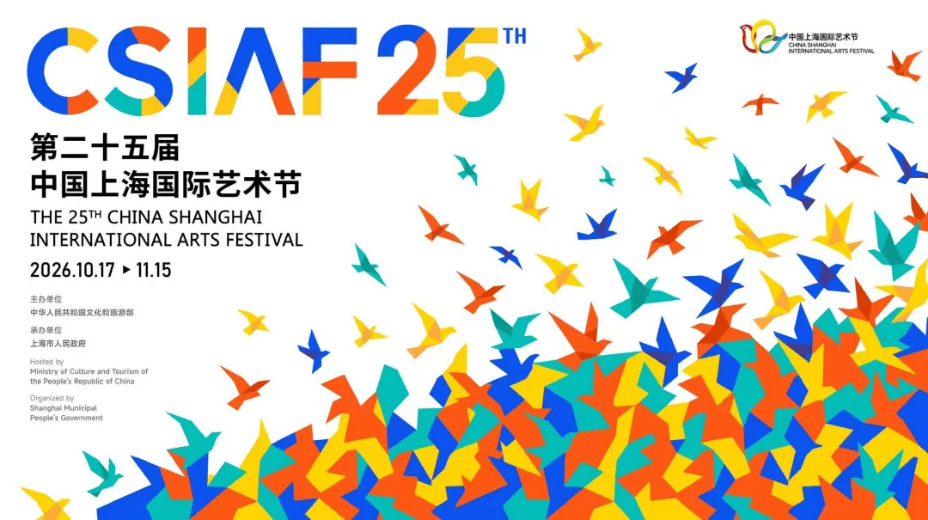
The 25th China Shanghai International Arts Festival (CSIAF) will run from October 17 to November 15, presenting nearly 400 programs comprising close to 1,100 performances, exhibitions and other events. Its eight sections include “Global Art” stage performances, the Rising Artists’ Works (R.A.W.!) program, “Art Space” community-focused art events and the “Arts Plus” art education programs.
Source: International Services Shanghai
2.West Bund Theatre Unveils 2026/27 “Human 2 Human” New Year Season
[Keywords: West Bund Theatre]

Shanghai’s West Bund Theatre recently unveiled its 2026/27 “Human 2 Human” New Year performance season, featuring seven major productions and 60 performances.